
Defining Word: Micro-Impact
An excerpt from Grace Will Be There, by Katie Kelley


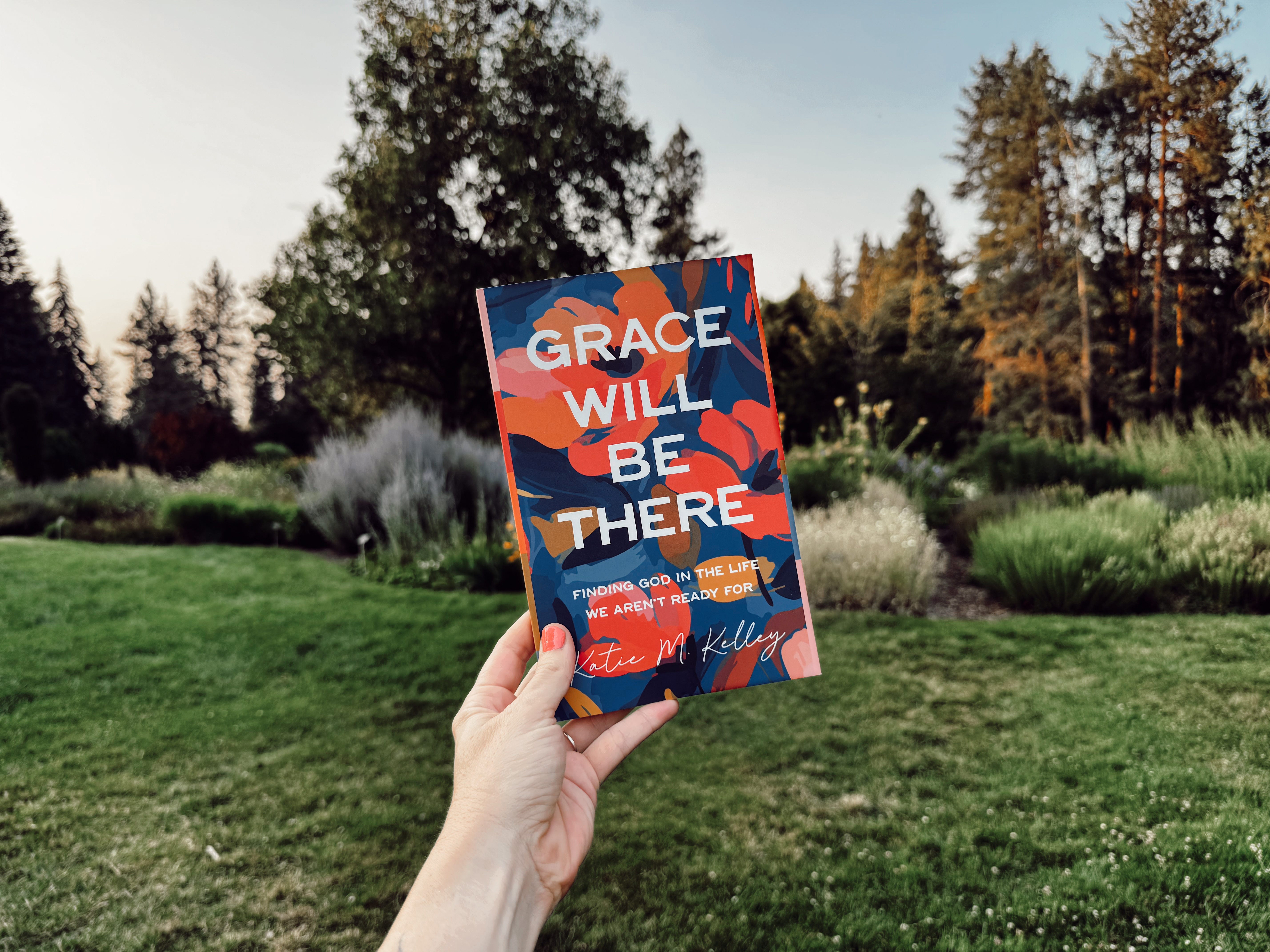
In honor of Katie’s book, Grace Will Be There, launching into the world today, we are sharing an essay from the book with our Coffee + Crumbs community 💚 Be sure to order your own copy of the book, and maybe one for a friend! It’s available wherever books are sold.
Oh, and Katie asked us to remind you: 5-star reviews on Amazon are much appreciated. And if you don’t like the book, no hard feelings! Just go ahead and feel free to skip that review 😂
1First, a short grammar lesson. When used as an adjective, the word micro means “extremely small.” If I use that adjective to describe the noun impact—which is, of course, what adjectives do—I end up with something like this: The extremely small effect or influence of one person, thing, or action on another.
My two-year-old is fussy, clingy, wanting nothing but mommy while mommy is trying to finish dinner. He has inched his way in between the counter I am standing at and my body, demanding I respond to his presence. This moment—the one between my thoughts and my behavior—it’s the choice. Is this an interruption, or an invitation? I’ve chosen wrong so often, but today, I lift him up underneath his arms, and hold him high so that my face is level with his chubby belly. With a giggle and a taunting I’m gonna get you, I nose into his belly button, and blow until the sound dances off his skin. He giggles hysterically and tries to inch his shirt back down to protect himself from the tickles. I put him down and off he runs, no longer demanding anything, just thankful to have been seen.
The agent emails me back a short, courteous, to-the-point response: “At this point, I’m going to encourage you to work on building your platform.” Get bigger, she is telling me. The other agent, he emails back, too: “We don’t believe that stories meet the felt need of the reader.” Find a more exciting idea, he says, something that can be packaged into a click-worthy sentence and sold to the masses. So if I want to be a real writer, you’re telling me I have to be bigger than I am, and more exciting than my real stories?
My daughter is four years old, and naturally has the kind of blonde hair people pay a lot of money to get. A gift from her biological mother, certainly not from me. But other areas of her life are less enviable than her hair. Trauma is real for children, too, and we see it play out for her in numerous ways. We take things slower with Ava: colors, letters, numbers, emotions, discipline. Micro-lessons, micro-steps. But absolutely, macro patience, something I admittedly do not always carry in ample supply. But just recently, after printing three, maybe four dozen name tracing sheets and sitting at the table forcing her hand to do what it just couldn’t seem to get comfortable doing, she finally did one on her own. All on her own. Picked the pencil out of the bowl, concentrated on her paper, traced her lines as close to the letters of her name as I’ve ever seen them, her pencil held almost correctly. “A for Ava,” she held it up proudly, showing her smile, with her wispy, wavy blonde hair falling over the eyes that were squinting with delight. If you could take a picture of pride, this would be the face of it.
Eighteen months after the agent emails and the closed doors, I published a book anyway. Not out of any sort of spite, but simply because my best friend sat across a coffee table and told me my stories mattered to people, that they could serve others, that truth and beauty and goodness didn’t need to be limited to a marketable phrase or an eye-catching platform number.
And then a friend tells me, “Katie, I sent your book to a friend, she shared it with another friend, that woman is changed forever.” And I get another email—a few dozen of them, actually, and I’ve saved every single one—that say things like, “I’m only on page ten and I can’t stop crying,” and “my teenager who doesn’t even have autism read your book and loved it” and “thank you, Katie, the amount of people you have made feel seen and loved is immeasurable.” And I wonder, what if I had believed those words about platforms and stories? What if I had thought the only way to make an impact was to make a big one?
I see him every day of the week. Every single day. Rain or shine or snow or wind, he’s out there for miles and miles at a time. He’s my hero, this older man—I’m guessing in his mid to late 80s—jogging our neighborhood. Mostly he shuffles his feet, hunched over noticeably, but moving forward at a clip enviable to anyone watching. Last week we crossed paths at the stop sign, and he waved me forward before he crossed, giving me the perfect opportunity to roll down my window and say, “You’re amazing, you know!” And he smiled and swatted away my compliment right out of the air with his glove, like he was saying this is nothing, this running every day. But then he yelled over the hum of the car engine, “I’m just glad to still be here!” And I smiled back at him, and pulled away from that stop sign a little bit different.
My counselor told me once, at the height of the darkness, when I had been feeling my way around a life where the lights had been turned off and I couldn’t find the door to safety, “Wrap your mind around the possibility that you can still be yourself through all of this, Katie, that you don’t have to change who you are.” When I look back, I think it was that day, around that micro-conversation, that I started to feel better.
When my son was diagnosed with autism, I left the doctor with tears in my eyes, got in the car, and texted my parents. My Dad told me, promised me, he would be there for this little boy, even though no one was sure what connection and bonding and healthy attachment would look like for him. And the text messages still come every week: Can I take Cannon to Jump and Bounce today? Or Can I pick Cannon up from school before the bus gets him? Or Would Cannon want to hang out with me so you can go to church without worry? Micro-texts. Micro-investments. Thousands of them. Today, seven years after that doctor appointment, seven years since my Dad told me he would be there, Cannon is at school, looking out the classroom window that faces the parking lot. I’m at home when my phone buzzes on the counter top with a message from his teacher: “Cannon is just standing at the window, happy as can be, saying, ‘Papa. Where’s Papa? Papa’s coming!’ He loves his Papa so much.”
Yesterday I was so tired, so spent, so utterly out of energy for my life and so dizzy with decision fatigue that all I wanted to do was curl up in a blanket and eat a warm cookie. Or seven. But at lunch time, I forced myself to the kitchen, and mustered up one more small choice: I made a salad.
My oldest child was browsing her old teacher’s blog when, through no fault of her own, a hacked link took her to a site I had wished she never, ever would find. Armed with many talks from us about what to do if this ever happened, she closed the computer quickly, ran to her room, and started praying for God to help her forget what she saw. But that’s no easy task, not for any of us. A good cry and a good conversation later, I was ready to get back to the day, to the workout I hadn’t finished, to the dishwasher beeping at me that it was done. “Mom,” she came into the kitchen and asked, “Can you just lay in bed with me for a while, until I feel better?” And right after I picked my heart off the floor, we did just that.
A few years after I dipped my toe into the public writing world, trying to do something bigger than what I was doing, my platform had grown. For a minute, I thought about emailing that agent again, asking her to take another look at my credentials, “Have I made it? Am I good enough now?” But something in me had changed. Bigger was no longer better, no longer what I wanted. My life had been shaken by storms that I never anticipated, and in the aftermath of the turmoil, idols and selfish motives and all manner of debris from a life of wanting to be important were torn up from the roots and left in piles by the side of the road. But in the midst of the mess, I could look up and see the sky more clearly. I think I finally saw, in the place where my idols of success used to be, all the micro-impacts of my writing, all the ways those early mornings and tear stained hours at the computer, looking for the perfect sentence to say what I meant to say, had made tiny differences to someone. And those things, those micro-impacts, were always meant to be pointing my eyes up.
Micro things are so small you can’t see them, or they are at least reduced to a very, very small scale. They are measured in the millionths—which I don’t know anything about because my math aptitude hits the ceiling at long division—but I do believe that is many, many decimal points away from one. Still, there is no macro—what the dictionary defines as large or large-scale—without a whole lot of micros. There is no big picture without a million tiny ones. There is no period of time not reduced to the microseconds that make it up. Not motherhood. Not friendship. Not a career. Not life. Nothing big exists without all of the micro pieces that hold it together.
Katie Kelley lives in the Pacific Northwest, where she is the mama to eight in a beautiful blended family. She is saved by grace and runs on cold brew coffee and long therapy sessions on her Peloton bike. You can read more of her writing on faith, motherhood, disability, and a good, good God over at Substack.
Essay format inspired by the late Amy Krause Rosenthal
 | A guest post by
|
Happy book release day to Katie!! It’s such a gift. (And would MAKE a good gift, so buy it, haha.)
So good! And the book is so good! (Five star Review written!)